


The Grottaferrata area preserves archaeological remains that tell a story dating back many centuries before the founding of the Abbey of San Nilo and the Tuscolan Villas. Among the most significant sites is Villa Cavalletti, where archaeology and agriculture come together within a landscape shaped over the centuries.
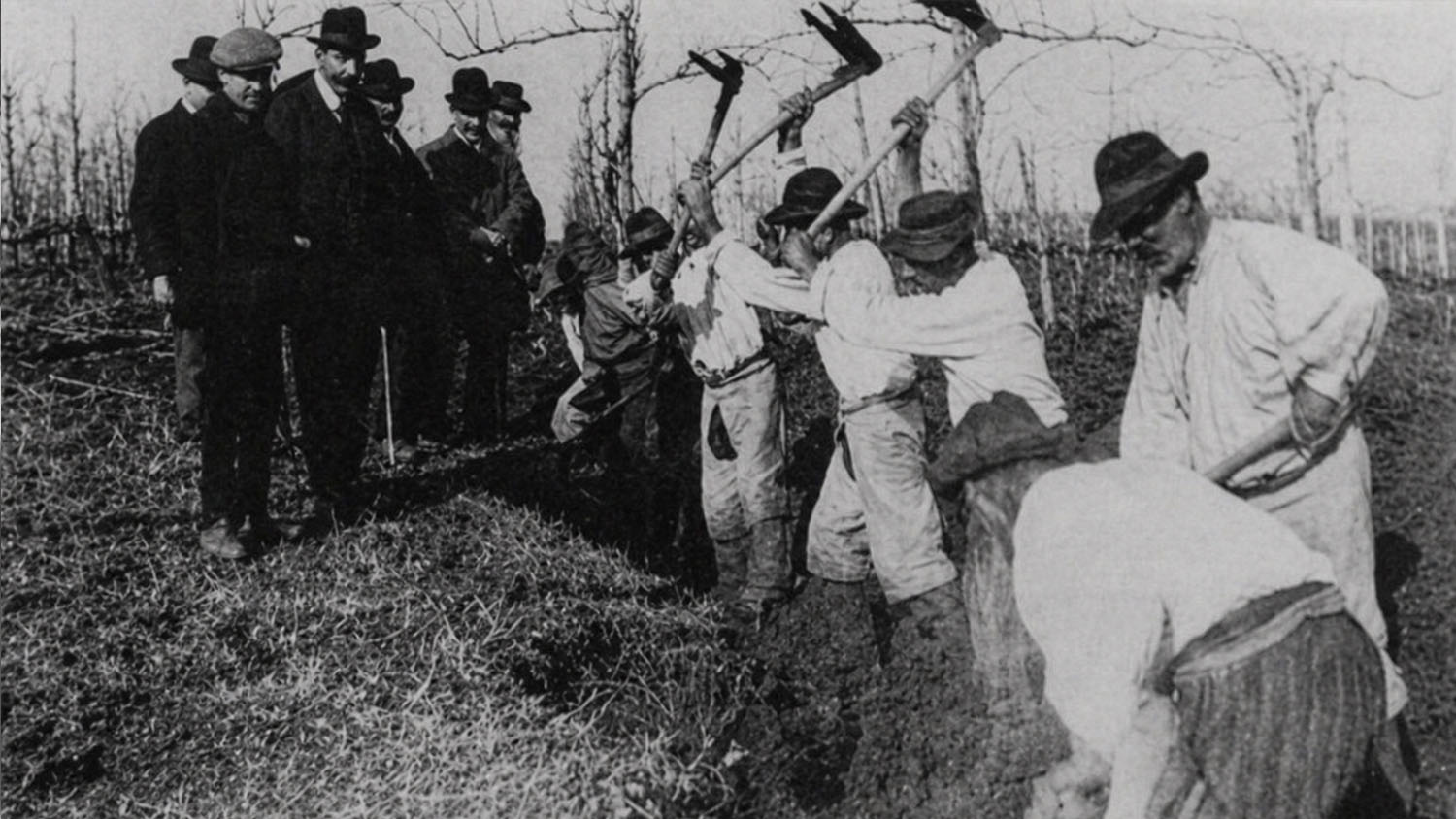
Between late 1901 and early 1902, while work was underway to plant a vineyard, a necropolis was discovered on the property. In February 1902, Marquis Cavalletti informed the authorities of the discovery, and archaeologists Giuseppe Angelo Colini and Raniero Mengarelli traveled to the site to study the burials and the numerous artifacts found there.
The grave goods indicate that the area was already inhabited as early as the first half of the 9th century B.C. The burials included large terracotta containers intended to hold the cinerary urns and the objects that had belonged to the deceased. Some later discoveries have also led to the hypothesis that there were inhumation graves in the area.
The excavations have revealed at least seven relatively intact grave goods and other materials that can be partially reconstructed. One of the tombs excavated scientifically has been dated to the first quarter of the 8th century B.C., suggesting that the necropolis was in use for a longer period than initially assumed.
The artifacts from the Villa Cavalletti burial ground have been preserved at the Luigi Pigorini National Prehistoric and Ethnographic Museum in Rome, where a room was previously dedicated to the most representative finds from the Grottaferrata necropolis.
The Archaeological Map also indicates, within the Villa Cavalletti area, the presence of the western substructures of a Roman villa. Part of the structures is now covered by soil, but to the south, a short section of wall built in the reticulated style is still recognizable. Several ancient paving stones that have been reused along a path have also been identified in the area.
It has been hypothesized that the hill may correspond to the ancient Colle Corne mentioned by Pliny the Elder and located in the Tuscolan area. While this identification has not been definitively proven, it confirms scholars’ interest in an area where archaeological evidence spans different eras.
The necropolis, the Roman villa, and the artifacts discovered there attest to the importance of Villa Cavalletti within the network of ancient settlements in the Alban Hills. This heritage is an integral part of Grottaferrata’s history and helps define its character as the noble heart of the Castelli Romani.
Book your experience at VILLA CAVALLETTI at: https://www.villacavalletti.it/esperienze/