


THE COMPLEX
THE THOUSAND SHADES OF THE CASTELLI ROMANI
Villa Cavalletti covers 27 hectares in Grottaferrata, in the heart of the Castelli Romani, within a landscape shaped by the ancient Latium Volcano. The estate encompasses the historic park, the historic vineyard, the field of heirloom grains, and the historic olive grove designated as a Slow Food Presidium of Centennial Olive Trees. Together with the Historic Villa, the Academy, the Farm, and the Olive Oil Museum, architecture and nature form a unified heritage, opening out onto the Roman countryside and Rome.
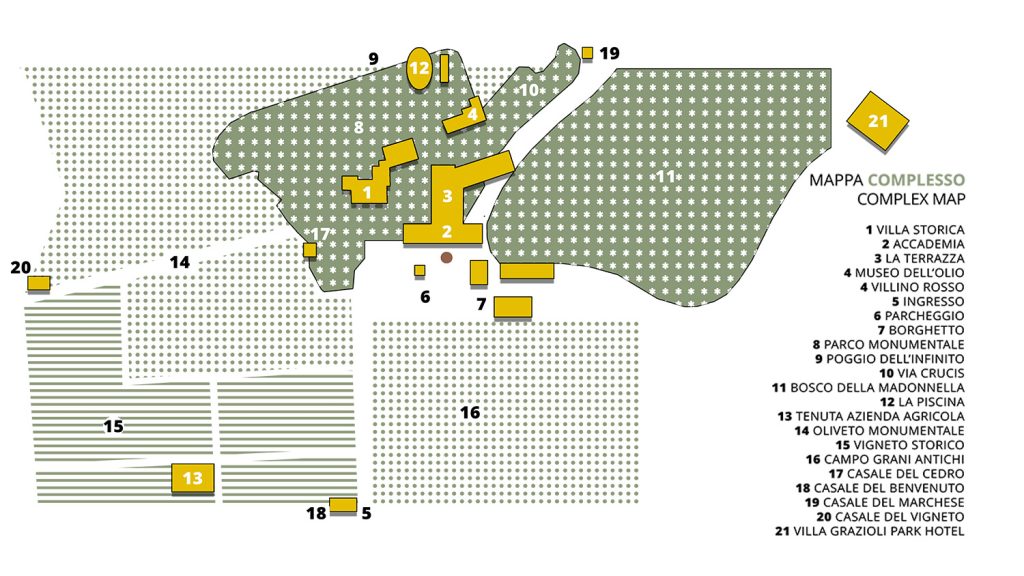
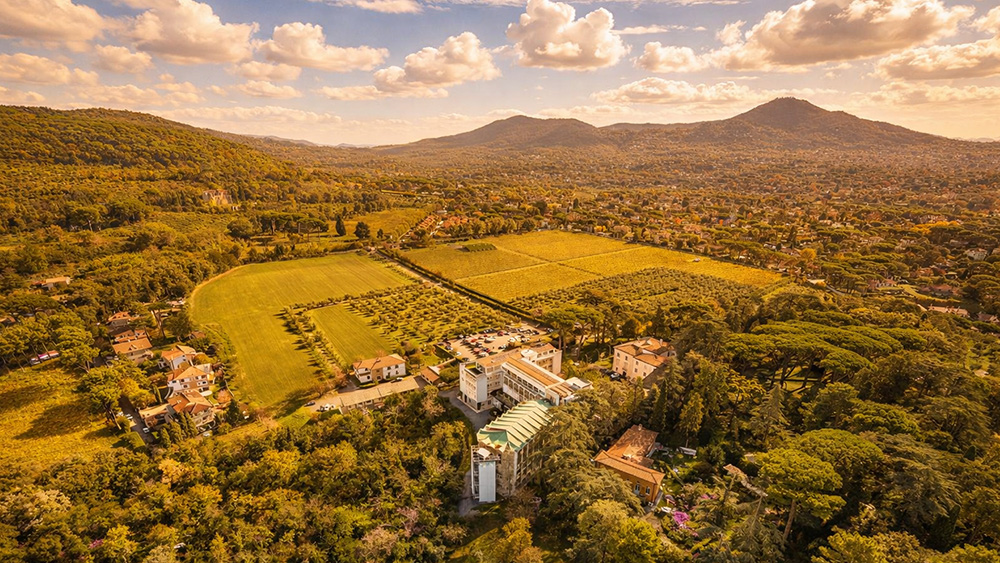
A panoramic view of the Villa Cavalletti complex, 27 hectares of natural beauty
THE LAZIO VOLCANO
The volcanic origin of the region has profoundly shaped the landscape and determined the extraordinary fertility of the soil. The eruptions of the Laziale Volcano, which gave rise to the current Colli Albani mountain range, left behind deposits of tuff, peperino, and pozzolana—materials that still characterize local architecture today and have, over the centuries, fostered the development of viticulture and olive growing. The numerous eruptive phases have also created a unique topography, characterized by two concentric crater rings separated by a vast volcanic plain stretching over twenty kilometers, defining one of the most significant geological landscapes in Lazio. The Villa Cavalletti estate is situated right within a volcanic crater, a unique feature that has shaped the agricultural development of the estate throughout its history.
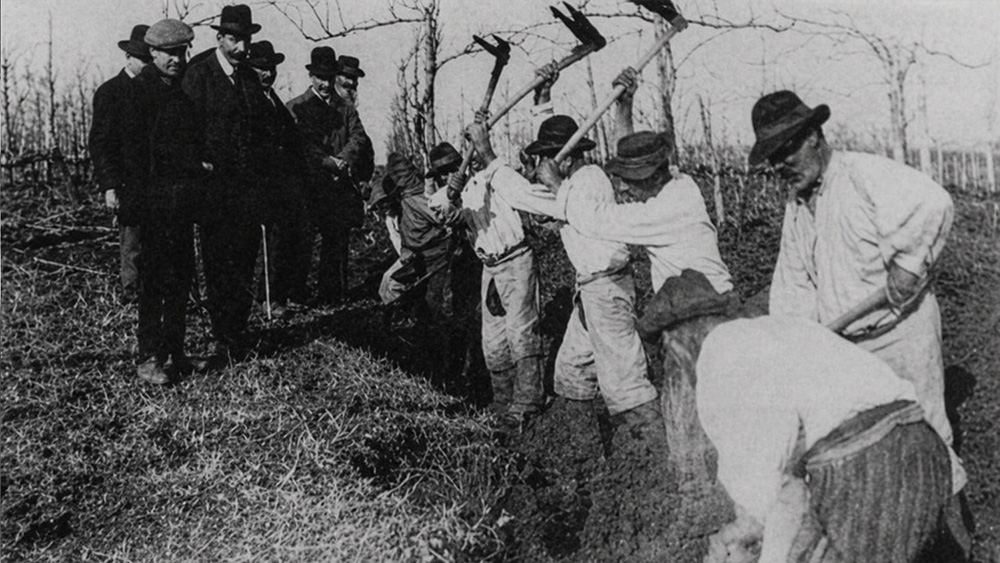
1902 Archaeological Excavation Campaign
Villa Cavalletti, Grottaferrata
ARCHAEOLOGY AND THE ROMAN ERA
The history of Villa Cavalletti dates back to ancient times. In 1902, while planting a vineyard, an Iron Age necropolis dating from the 8th to the 7th century B.C. was discovered on the estate, providing important evidence of the Latin populations of Latium Vetus. Even in pre-Roman times, viticulture was linked to the religious cults of nearby Monte Cavo, home to the sanctuary of Jupiter Laziale. With the rise of Rome, the area became one of the favorite destinations for aristocratic leisure: villas, gardens, and farms took advantage of the fertility of the volcanic soils and the abundance of water. The archaeological remains discovered on the estate attest to a continuous settlement spanning over two thousand years of history.
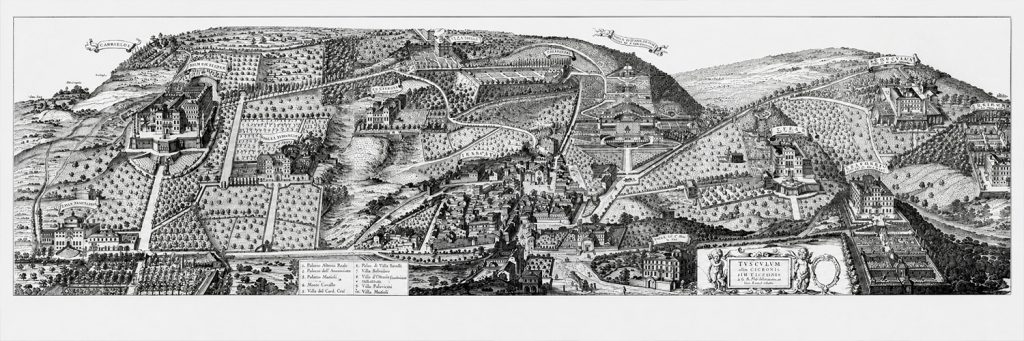
View of Frascati and the Tusculan Villas (Tusculum)
etching and engraving on copper, 17th century (ca. 1670–1700)
ROMAN RUSTIC VILLA
The extraordinary scenic beauty of the Alban Hills was described as early as ancient times by Strabo, who in the 1st century B.C. described a region rich in water, farmland, and sumptuous residences overlooking Rome. The slopes of Mount Tuscolo and Mount Albano were home to rustic villas and country residences that combined agricultural activities with ceremonial functions. It is within this context that the earliest history of the Villa Cavalletti site unfolds, as part of a regional system that, since Roman times, has drawn its primary wealth from the fertility of the volcanic soil and the beauty of the landscape.
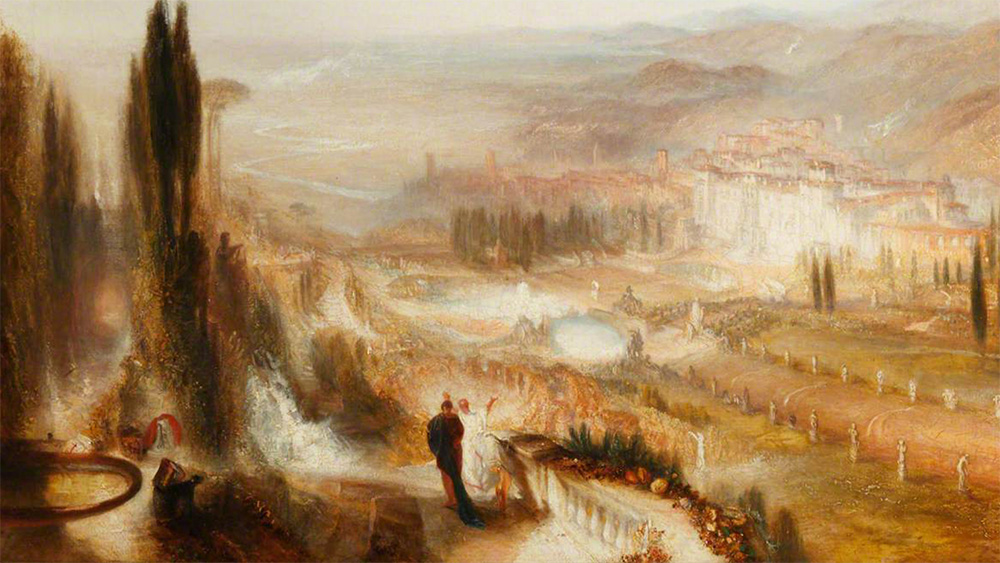
Cicero at his villa in Tusculum
Joseph Mallord William Turner (1775–1851) National Trust, Ascott
GRAND TOUR
Villa Cavalletti is a historic estate in the heart of the Castelli Romani, nestled in a landscape of extraordinary beauty with a view of Rome. Its origins date back to the 16th century, when it belonged to Cardinal Federico Cesi and later to the Cavalletti family. A significant example of a Villa Tuscolana, it integrates architecture, gardens, and farmland into a single landscape system. Over the centuries, it has been a destination for travelers, scholars, and prominent figures drawn to the charm of the Alban Hills, and it still retains today the character of a privileged place for observing and discovering the region.
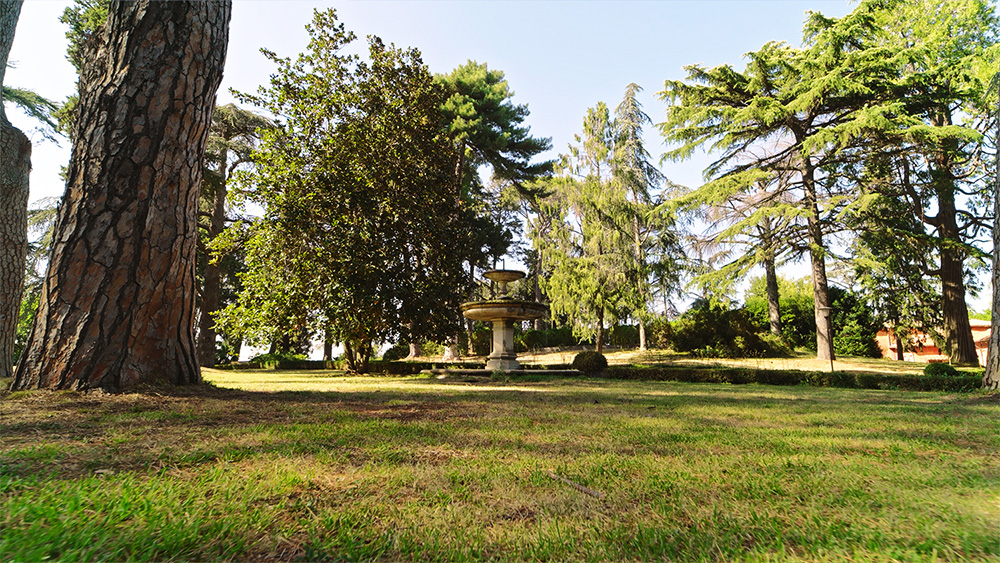
View of the historic fountain inside the Monumental Park of the Villa Cavalletti estate
AGRICULTURAL AND MONUMENTAL LANDSCAPE
Villa Cavalletti is one of the few Tuscolan villas to have survived virtually intact to the present day. Its 27 hectares include monumental avenues, centuries-old olive groves, historic vineyards, and expansive green spaces overlooking Rome, the sea, and the Castelli Romani. Built beginning in 1580 by Cardinal Cesi and purchased in 1596 by Ermete Cavalletti, it was originally conceived as a vacation retreat and agricultural estate. Even today, it preserves the original relationship between architecture, landscape, and rural activities that characterizes the tradition of the great villas of the Tuscolan area—a feature also highlighted by Slow Food’s recognition as a “Presidium of Centuries-Old Olive Trees.”
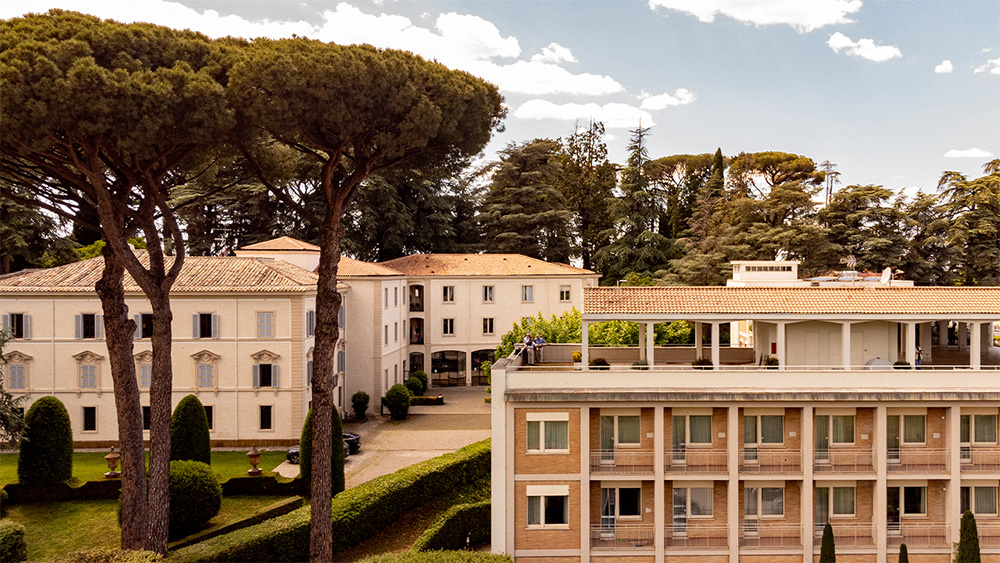
Aerial view of the Villa Cavalletti complex
The Academy is in the foreground, with the historic villa in the background
A PLACE BELOVED BY TWO POPES
In the 20th century, Villa Cavalletti became an important center for spirituality, education, and international dialogue. Since the 1960s, it has been home to the General Curia of the Society of Jesus, led by Father Pedro Arrupe, and was frequented by Jorge Mario Bergoglio—the future Pope Francis—who was then Provincial of the Jesuits in Argentina. His connection with Joseph Ratzinger, on the other hand, stemmed from the support he offered to the Catholic Community for Integration and led, in 2003, to the founding of the Academy for the Theology of the People of God on the estate: a center for study and dialogue overseen by the future Pope Benedict XVI.
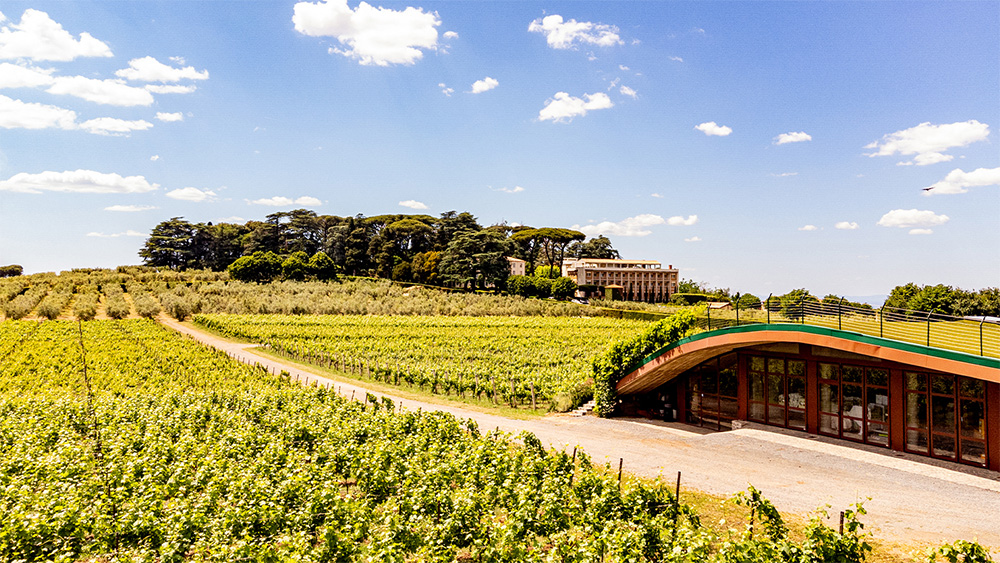
View of the Villa Cavalletti complex. In the foreground is the organic farm.
THE REBIRTH OF VILLA CAVALLETTI
Since 2014, Villa Cavalletti has been at the center of a major regeneration process based on environmental, social, and economic sustainability. The project has involved the restoration of the buildings according to green building principles, the preservation of the historic park, and the promotion of agricultural production through organic farming methods. The estate’s rebirth is rooted in respect for its historical and landscape identity, reinterpreted in a contemporary key to restore to the region a place capable of combining culture, agriculture, hospitality, and heritage preservation.