


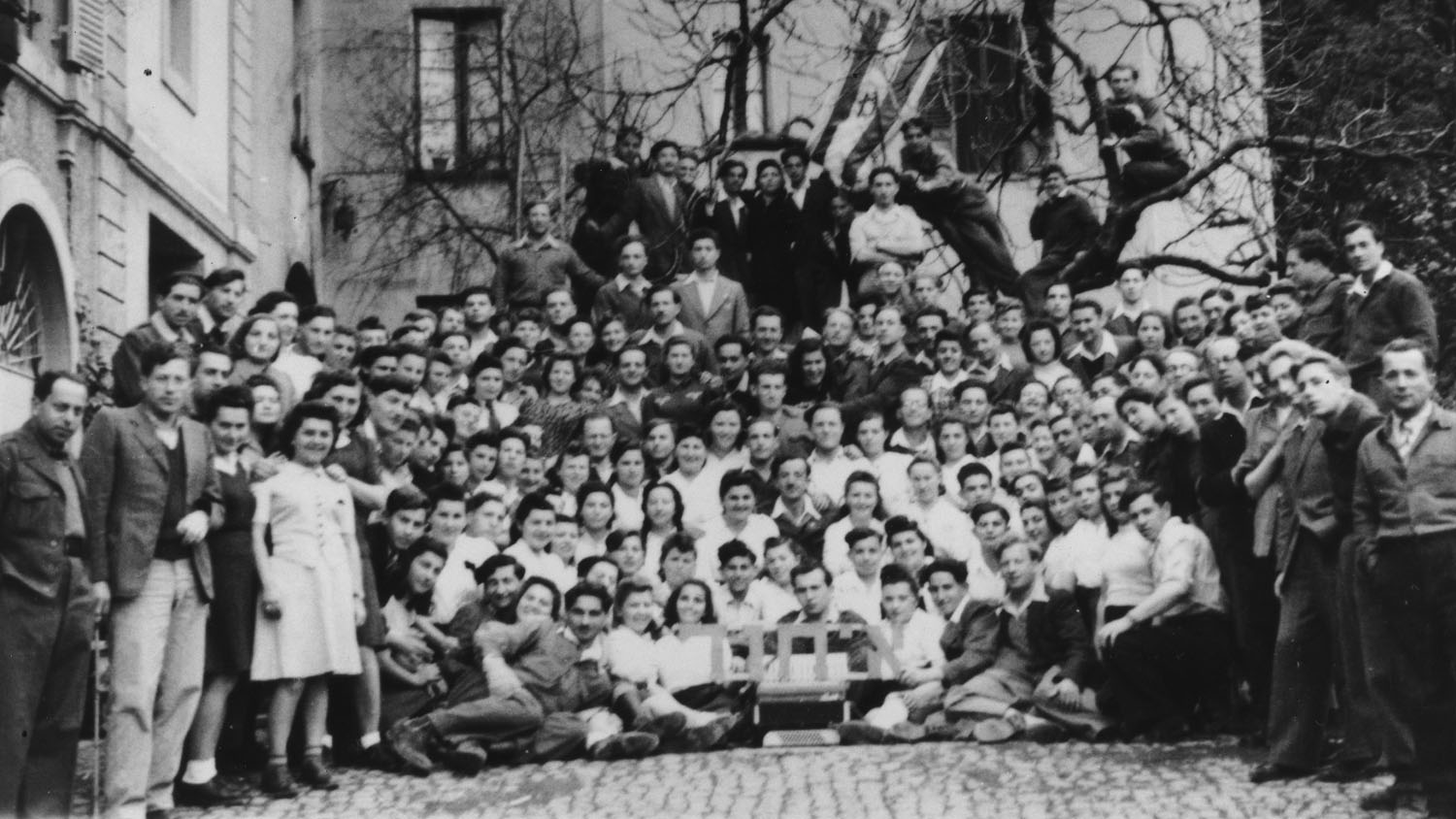
The history of Villa Cavalletti in the post-World War II era exhibits a unique thematic continuity that sets it apart from many other historic residences in the Rome area. After hosting the Ichud Kibbutz in 1946 and numerous young Holocaust survivors awaiting emigration to Palestine, the complex became, several decades later, a center for religious and cultural initiatives dedicated to exploring the relationship between Christianity, Judaism, and contemporary society.
In postwar Europe, the tragedy of the Holocaust posed a series of unprecedented questions for the Christian churches regarding the historical responsibilities of religious anti-Semitism, their relationship with the Jewish people, and the role of faith in building a democratic society. These issues reached a turning point at the Second Vatican Council (1962–1965), particularly with the declaration *Nostra Aetate*, which ushered in a new era of dialogue between the Catholic Church and Judaism.
It is within this context that the Catholic Integrated Community (Katholische Integrierte Gemeinde) finds its place; it was founded in Germany after World War II on the initiative of Herbert and Traudl Wallbrecher. The Community developed as an ecclesial laboratory dedicated to integrating Christian life, culture, civic responsibility, and theological research. Of particular significance were the studies dedicated to the Jewish roots of Christianity and to overcoming the forms of hostility that had marked relations between the two religious traditions for centuries.
The Community’s establishment at Villa Cavalletti and the subsequent founding of the Academy for the Theology of the People of God transformed the complex into an international center for study and dialogue. Here, meetings, seminars, and conferences were held dedicated to Jewish-Christian dialogue, theological reflection, and the cultural challenges posed by modernity. The initiative received the support of Cardinal Joseph Ratzinger, the future Pope Benedict XVI, who recognized the Community’s work as a significant contribution to the theological renewal promoted by the Second Vatican Council.
The presence of the Catholic Community for Integration thus gave Villa Cavalletti a role that, while different from the one it had played in 1946, was part of the same historical perspective: the search for cultural and spiritual tools capable of fostering mutual understanding among peoples and religions in the wake of the tragedies of the 20th century. From this perspective, the villa became not only a place of hospitality and education, but also a center for reflection that focused on human dignity, historical memory, and dialogue among religious traditions.
The history of Villa Cavalletti thus bears witness to the evolution of a place that, throughout the 20th century, has been part of some of the major transformations of European society: from the physical and moral reconstruction of the postwar period to the deepening of Jewish-Christian dialogue, and on to the new forms of cultural and religious exchange that emerged at the beginning of the 21st century.
Book your experience at VILLA CAVALLETTI at: https://www.villacavalletti.it/esperienze/